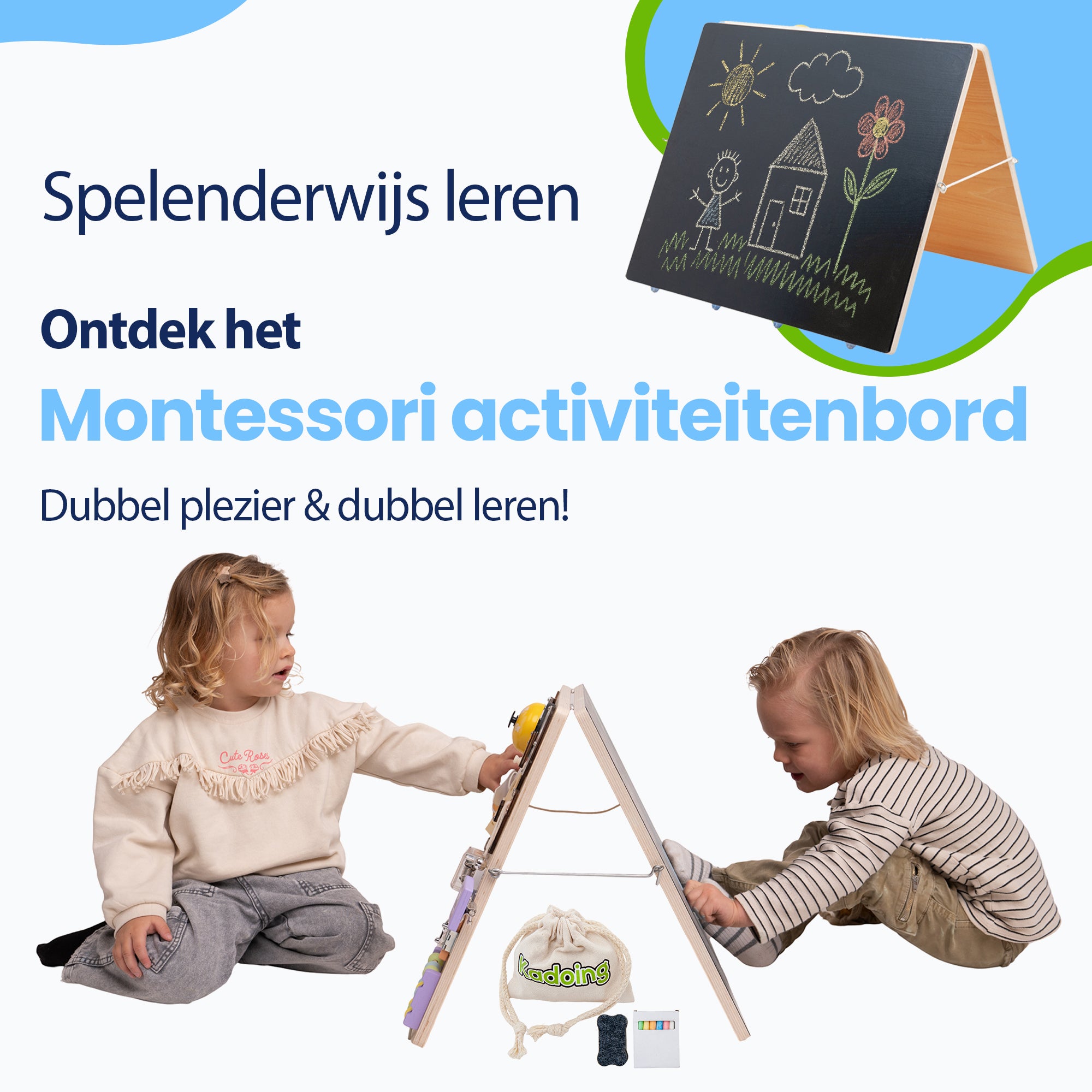
A child who constantly wants to touch zippers, buttons, switches and little doors is not being difficult — they are learning. That is exactly where the answer to the question “what is a busy board?” begins. A busy board is an activity board filled with everyday objects that allow young children to safely touch, slide, twist, open and close things. It is a toy, but with a clear purpose: helping children practice real-life skills through play in a way that later feels completely natural.
For many parents, that immediately makes sense. Young children are naturally fascinated by things they see adults using. A buckle on a bag, a light switch, shoelaces or a small lock on a cabinet are not small details to a toddler — they are exciting discoveries. A busy board brings those kinds of actions together in one place, at child height and in a safe format.
What exactly is a busy board and how does it work?
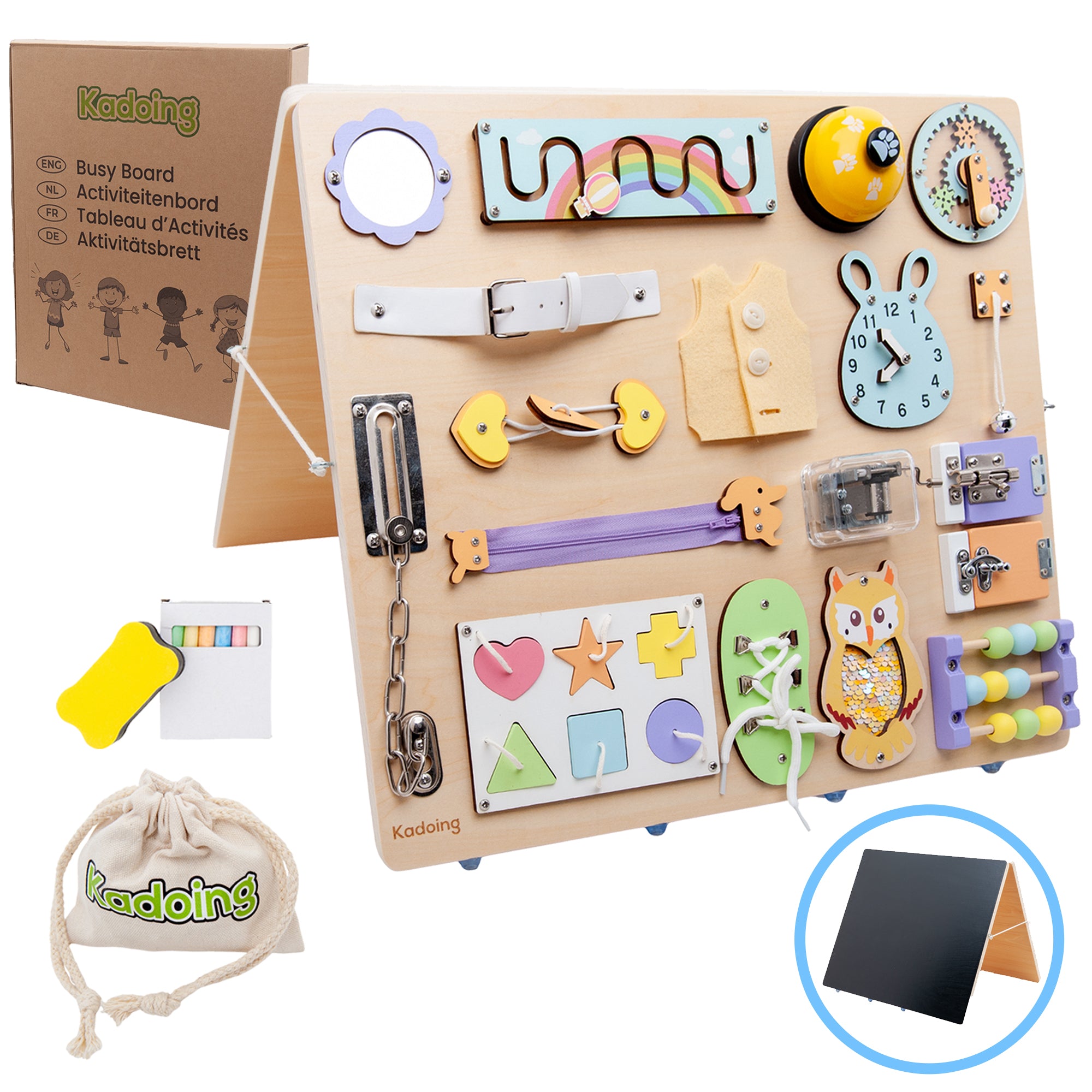
A busy board, sometimes called an activity board or Montessori board, is usually a wooden board filled with movable elements. Think of shoelaces, zippers, spinning wheels, sliders, buckles, buttons, gears, bells or little doors. The idea is simple: children use their hands, eyes and concentration to figure out how things work.
That is what makes a busy board different from toys that mainly create sound or light without requiring much effort from the child. Here, learning happens through doing. A child discovers that a slider only opens when pushed in the right direction, or that a buckle only comes loose with the correct movement. Those small successes create a real sense of satisfaction.
Busy boards are often associated with Montessori-inspired toys because they encourage independent exploration, repetition and practical learning. That does not mean every child plays with them in the same way. Some children become completely absorbed in a zipper, while others mainly enjoy spinning parts. And that is exactly what makes them so valuable: they leave room for the child’s own pace and curiosity.
Why do young children love busy boards so much?
Young children learn with their whole body, but especially with their hands. They do not just want to look — they want to experience things. A busy board fits perfectly with that need because it offers physical actions with immediate reactions. Turn something and it moves. Push something and it clicks. Pull something and it opens.
That direct feedback makes play feel understandable and calming because there is clear logic behind it. For toddlers and preschoolers, that is comforting while they are still learning how the world works. A busy board is therefore not hectic entertainment, but a playful way of understanding cause and effect.
Many parents notice that busy boards work especially well during quieter moments — in the morning, after daycare or before dinner. During those times, simple and focused toys often work much better than loud toys filled with lights and sounds.
Recognition also plays a major role. Elements such as buckles, locks and buttons come directly from daily life. Children recognise them from shoes, coats, bags or furniture. That makes the play feel meaningful. It is not simply passing time, but practicing things they will eventually use themselves.
What does a child learn from a busy board?
The biggest strength of a busy board is the combination of play and development. While children are having fun, they are also practicing several important skills at the same time.
Fine motor skills improve significantly. Small fingers learn how to grip, twist, pull and slide with precision. That later helps with dressing, drawing and creative activities. Hand-eye coordination is also strengthened because children carefully watch their movements and gradually learn to control them better.
A busy board also supports concentration. A lock does not always open immediately. A child tries again, adjusts the movement and discovers what works. That requires patience and focus. The repetition itself is valuable. Not because children need to “perform,” but because they learn that practice changes outcomes.
There is also a strong element of independence. Many parents recognise the proud expression on a child’s face when something finally works. Opening a buckle independently or closing a zipper may seem small to adults, but for a young child it feels like a major achievement. Those moments build confidence.
Some busy boards include extra elements such as shapes, colours, numbers or different textures. That can be enriching, as long as the board does not become visually overwhelming. Especially for younger children, simplicity often works better than too many stimuli at once.
What age is a busy board suitable for?
That depends on both the design and the child. Many busy boards are suitable from around 10 months up to about 4 years old. In practice, however, children use them differently depending on their developmental stage. Babies and younger toddlers mainly explore through touching and tapping. Older toddlers may intentionally practice opening, sliding, tying or fastening.
The best choice therefore depends not only on the age recommendation on the packaging, but also on the child’s current interests and abilities. If your child becomes frustrated quickly, a simpler board with a few clear elements often works better than a large board with many challenges. If your child already enjoys problem-solving and repetition, a more advanced board may be a better fit.
Safety should always come first. All parts should be firmly attached, smoothly finished and suitable for small children. Especially with younger children, supervision remains important even when the board is specifically designed for kids.
What should you look for when choosing a busy board?
As a parent, you naturally want something that is safe, educational and pleasant to use. A beautiful design is nice, but the board should also suit your child and daily life. A busy board that stays untouched in a cupboard because it feels too complicated quickly loses its value.
That is why it helps to first look at the structure of the board. A good busy board offers variety while still feeling organised. Multiple activities are great, as long as they do not all demand attention at the same time. Calm colours and balanced layouts often help children focus better.
The material matters just as much. Wood feels warm, sturdy and timeless, and fits perfectly with sustainable toys, provided the finishing is done properly. Smooth edges, child-safe paint and strong attachments are essential. Especially with products for small children, parents want reassurance about quality. Many families consciously choose wooden busy boards with sustainable materials, water-based paint and durable construction designed for intensive daily use.
Practical use also matters. Is the board portable? Can it be used on the floor, on a lap or mounted upright? Are you looking for something for home, travel or quiet playtime while you briefly need your hands free? The right choice depends on how and where you plan to use it.
What a busy board is not
A busy board is not a magical solution that instantly makes every child play independently for long periods of time. Some children love them immediately, while others need time to warm up to them. And some children become fascinated with just one element while ignoring the rest entirely. That is not wrong — it simply reflects what currently interests the child.
A busy board also does not replace free play, outdoor movement or reading together. It is simply one form of development-focused play within a broader world of toys and experiences. Variety is exactly what makes childhood play so valuable. Sometimes children want to build freely and use their imagination, while at other times they prefer calm and focused discovery.
That is why it helps to view a busy board as a supportive tool in everyday life. A few quiet minutes at the table while you finish something, calm exploration after a nap or practicing buckles and zippers together before getting dressed. Not as a learning obligation, but as playful support for the things children already naturally enjoy doing.
Does a busy board fit every family?
For many families, yes — precisely because it combines play with practical development. Parents who consciously choose fewer but better toys often appreciate that a busy board lasts a long time and supports multiple developmental skills at once. It also fits beautifully into calm play spaces where children can explore independently without becoming overstimulated.
At the same time, it should fit both the child and the household. Some children simply prefer larger physical movement over detailed fine motor activities. In that case, a busy board may be a nice addition rather than a favourite toy. And that is completely fine. Good toys do not have to mean the same thing for every child.
Parents who consciously choose child-friendly, sustainable materials and toys with a meaningful purpose often naturally gravitate toward activity boards like these. They fit beautifully into a calm and practical play environment. Not to add more stimulation, but to create small focused learning moments that quietly become important over time.
A busy board therefore does not need to be spectacular to be valuable. Its strength often lies in its simplicity. A child carefully trying to open a buckle is not “just playing” — they are slowly becoming more independent. And those are exactly the moments that often bring more calm, confidence and quality time into family life.
Frequently asked questions about busy boards
What age is a busy board suitable for?
Many busy boards are suitable from around 10 months up to approximately 4 years old, depending on the activities and difficulty level.
What does a child learn from a busy board?
A busy board helps develop fine motor skills, hand-eye coordination, concentration and independent exploration.
Is a busy board Montessori toy?
Many busy boards are Montessori-inspired because they focus on independent learning and practical discovery.
Are busy boards safe?
Yes, as long as all parts are securely attached and the board is made from child-safe materials.
What is the difference between a busy board and an activity board?
There is very little difference. “Busy board” is simply the English term often used for an activity board.