When you want to buy a Montessori activity board, you are usually not just looking for another toy. You are looking for something that genuinely keeps your child engaged — without loud sounds, without constant overstimulation, and with room for independent discovery. That is exactly where a good activity board stands out: it combines play, concentration, and development in a calm and meaningful way.
For many parents, that is exactly what makes it so appealing — especially during moments when a child wants to stay busy, but you do not want to keep introducing new toys all the time. An activity board encourages repetition, experimentation, and problem-solving. It fits perfectly with the way young children naturally explore the world with their hands.
Why Montessori activity boards are so popular
The popularity makes complete sense. A Montessori-inspired activity board follows the way young children learn: through touching, sliding, opening, turning, and discovering. Not because someone explains every step, but because the board itself naturally sparks curiosity.
That makes it very different from toys designed mainly for entertainment. A good activity board has a clear purpose. It supports fine motor skills, hand-eye coordination, and concentration. At the same time, it gives children a sense of independence. Closing a zipper, opening a buckle, or turning a knob may seem simple to adults, but for a toddler these are real exercises in control and confidence.
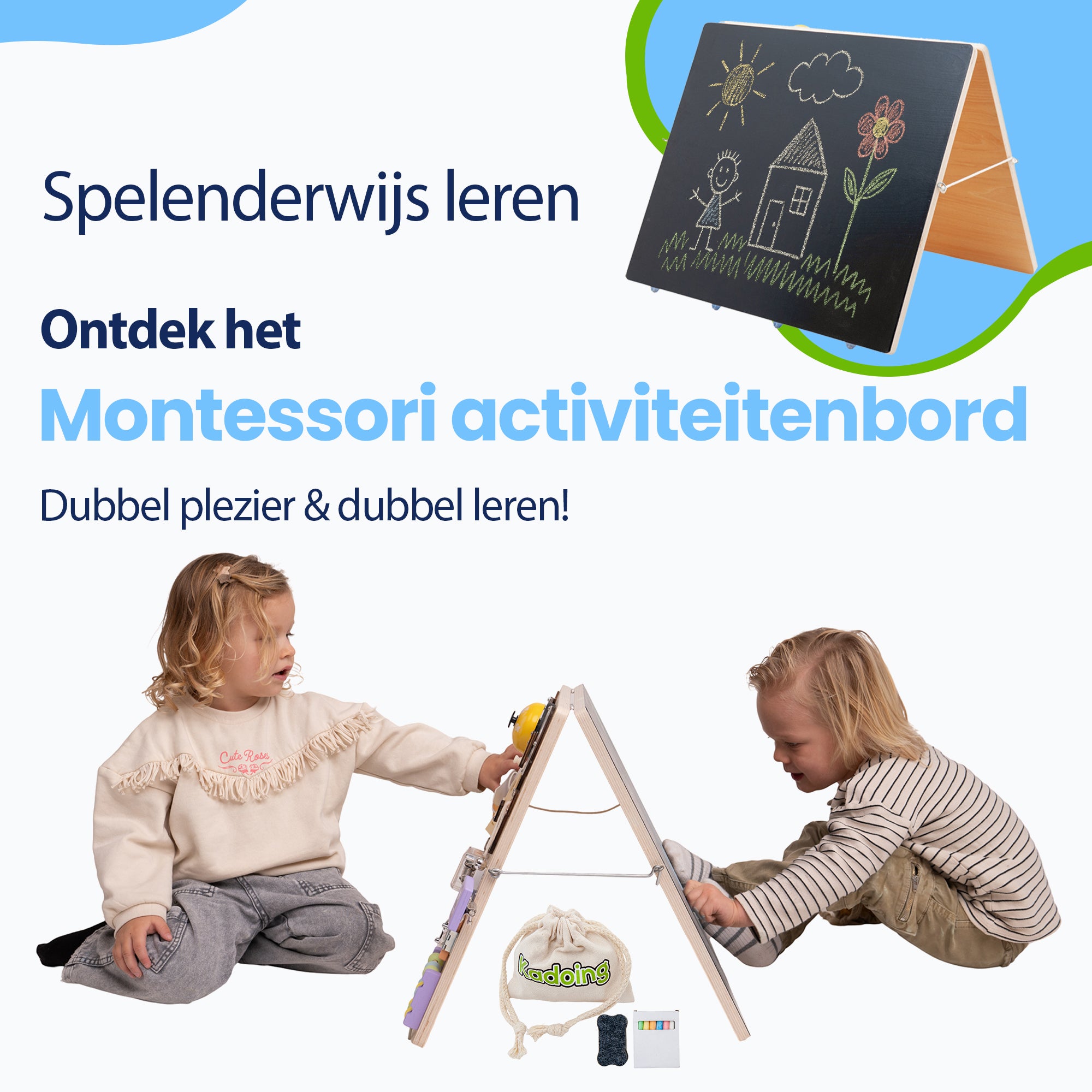
There is another reason why this type of toy has become so popular. Many parents notice that activity boards work especially well during calm moments — in the morning, after daycare, or before dinner. During those moments, quiet toys often work much better than toys filled with lights and sounds. Toys without intense stimulation usually feel calmer in the home and make focused play easier. No flashing lights or loud melodies, just concentrated play that fits naturally into rainy afternoons, quiet mornings, or peaceful moments together at the table.
What should you look for when buying a Montessori activity board?
Not every activity board or busy board is automatically a good choice. Many products use the Montessori label even though the actual design is chaotic, fragile, or impractical. That is why it is worth looking beyond attractive product photos.
Choose based on age and development stage
The age recommendation is a good starting point, but it is not the whole story. One child at eighteen months may mainly enjoy simple movements like pulling and sliding, while another may already be fascinated by switches, locks, and shoelaces. Instead of focusing only on the packaging, it helps to look at what your child currently enjoys exploring.
For younger toddlers, boards with larger and simpler elements often work best. Think of easy sliders, turning knobs, and soft fasteners. For older toddlers and preschoolers, more challenging elements such as buckles, zippers, Velcro, and simple locks can be more engaging.
If a board is too difficult, frustration appears quickly. If it is too easy, boredom follows just as fast. Some children can stay fascinated by the same buckle or latch for surprisingly long periods. Repetition helps support concentration, motor development, and independent exploration. The ideal choice sits somewhere in the middle — challenging enough to keep trying, but simple enough for success.
Safety should always come first
If you are seriously comparing Montessori activity boards, safety should always be your top priority. Young children explore intensely and still put objects in their mouths sometimes. That means small parts should be firmly attached and the board should not contain sharp edges or splinters.
Pay close attention to the materials and finish as well. Wood feels warm and durable, but it should always be smoothly sanded. Paint or coatings should be child-safe. Fabric parts should be securely attached and durable enough for everyday use.
It is also important to check whether the board feels stable. A loose panel that constantly tips over or slides around is simply less enjoyable for daily play.
Materials and durability matter
Many parents intentionally choose wooden activity boards made with sustainable materials, child-safe finishes, and strong construction. Think of FSC-certified wood, safe water-based paint, and durable designs built for daily use.
Because activity boards are often used intensively, quality differences become noticeable very quickly. A sturdy wooden board with reliable fastenings usually lasts much longer than a lightweight model made from thinner materials. That is not only practical, but also more sustainable when it can later be passed on to siblings or other families.
For many parents, appearance also matters. Calm colors and natural materials often fit more peacefully into the home and create fewer visual distractions for children. It may sound like a small detail, but it genuinely matters when you are trying to encourage focused and calm play.
Buying sustainably does not automatically mean buying the most expensive option. It mainly means choosing something durable, safely finished, and enjoyable for children over a longer period of time.
Which elements are actually valuable?
Not every extra feature adds value. Some boards look impressive at first glance, but mainly feel overcrowded. In many cases, a board with fewer well-chosen activities is much more effective than a chaotic design filled with stimulation.
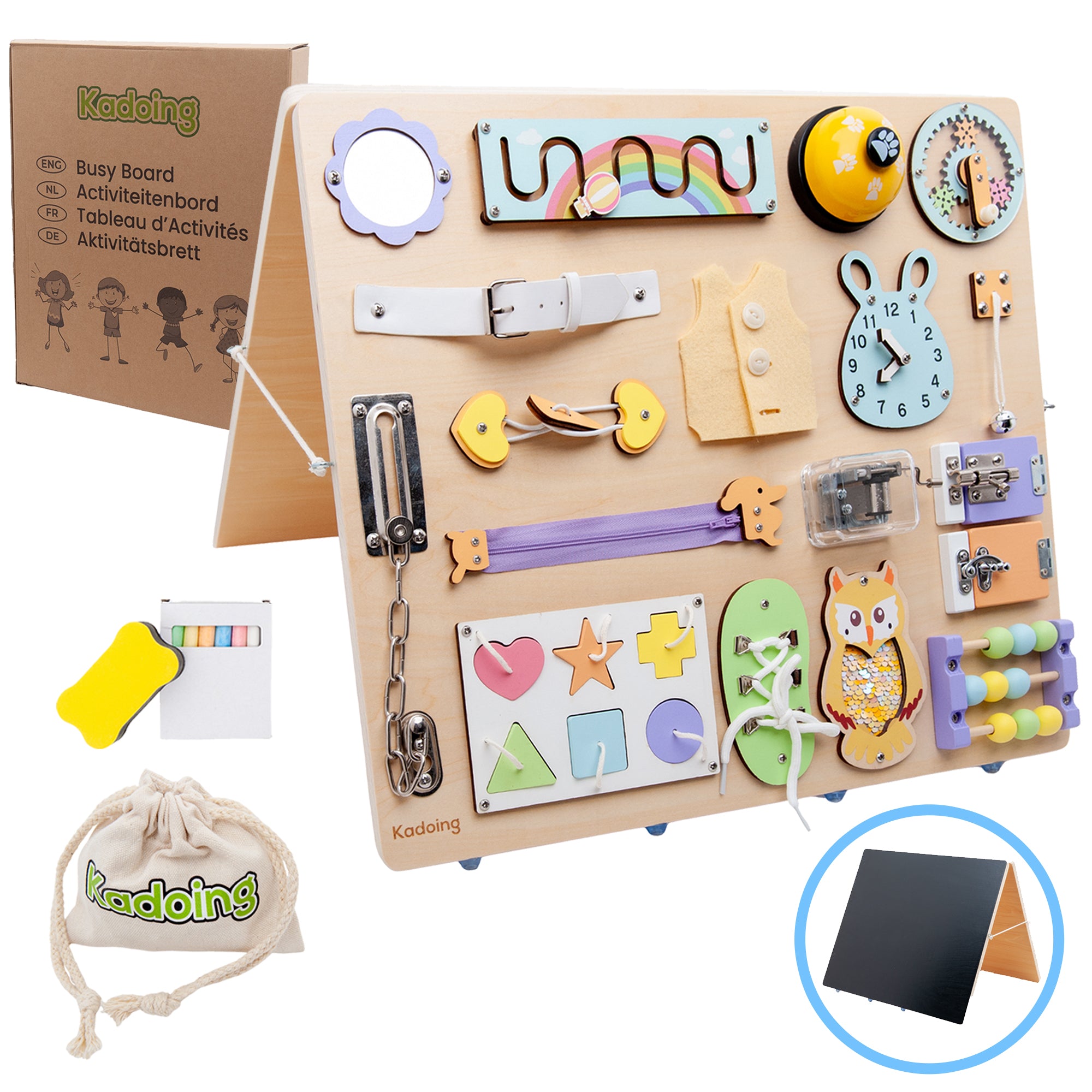
Elements such as zippers, buttons, click systems, spinning wheels, sliders, locks, and shoelaces often work extremely well. These are actions children also encounter in everyday life. That makes the play feel both familiar and meaningful. They are not only practicing movements, but also learning practical skills that later help with dressing and independence.
Light switches or simple cause-and-effect elements can also be exciting, as long as they do not dominate the entire board. It really depends on the child. Some children love them, while others prefer more tactile and mechanical activities.
For home, travel, or as a gift?
The best choice also depends on how you plan to use the board. For home use, a larger and sturdier model often works best. It can stay on the floor, at a table, or in a play corner and encourages longer periods of concentrated play.
For travel, a smaller activity board or soft fabric version is often more practical. In the car, at restaurants, or while visiting family, it helps to have something quiet, compact, and engaging without too many loose pieces. In those situations, size becomes just as important as the activities themselves.
As a gift, a Montessori activity board is especially popular because it feels thoughtful and practical. Parents often appreciate gifts that combine learning and calm play. Especially for a first birthday or toddler gift, it is something children genuinely use rather than something forgotten after a week.
What is a fair price?
Activity boards vary widely in price. That depends on size, materials, finishing, and the number of activities included. Cheaper boards may look attractive initially, but with this type of toy quality differences often appear quickly through loose parts, rough edges, or poorly functioning elements.
At the same time, expensive does not automatically mean better. Sometimes you mainly pay for appearance or extra features that add little practical value. It helps to focus on three things: how sturdy the board feels, whether the activities fit your child’s age, and whether the toy encourages repeated use.
If a board continues being used for months, it is often a much better investment than a cheaper alternative that loses attention after only a few days.
Does an activity board suit every child?
Usually yes — but not always in the same way. Some children immediately start exploring independently. Others first need a parent to sit beside them, demonstrate, and explore together. Both are completely normal.
Temperament also matters. Children who love movement may use an activity board mainly as a calm break, while children who enjoy precision and repetition can stay focused on it for surprisingly long periods.
That is why realistic expectations are important. An activity board is not a magical solution that instantly keeps every child quietly entertained for twenty minutes. It is more like a calm invitation to explore. Some children connect with it immediately, while for others interest grows gradually.
How to get more out of it at home
An activity board works best when it is easy to reach and not hidden between ten other toys. Giving it a permanent place naturally turns it into part of everyday life. That creates familiarity and calm.
Starting together often helps. Let your child touch and experiment, demonstrate a buckle once, and then allow space for independent exploration. That independence is important. Try not to help too quickly, even if it sometimes takes longer than you would like.
Parents who intentionally choose toys that support calm play and development often discover that less can actually mean more. That is why many families choose Montessori-inspired products from brands like Kadoing, where play, development, and peaceful routines come together naturally.
Buying a Montessori activity board with confidence
It is not about having the most features or the trendiest design. It is about safety, meaningful challenge, and choosing a toy that truly matches your child’s curiosity and developmental stage.
When you look at it that way, you are not simply buying something to play with. You are choosing something that supports independence, concentration, and calm moments of discovery. And often, those are exactly the moments parents value most.
Frequently asked questions about Montessori activity boards
At what age is an activity board suitable?
Most Montessori activity boards are suitable from around 1 year old, depending on the activities and difficulty level.
What is the difference between a busy board and an activity board?
Busy board is simply the English term for an activity board. Both focus on motor skill development and independent discovery.
Are wooden activity boards safe?
Yes, as long as they are well-made, contain no loose parts, and use child-safe materials.
How long will a child play with an activity board?
That depends on age and interest, but many children enjoy a good activity board for several months or even years.
Which elements are useful on a Montessori activity board?
Zippers, locks, buttons, sliders, shoelaces, and spinning elements are especially valuable for motor development and independent learning.